

THREE STEPS BETWEEN YOU AND UNLOCKING PRODUCTIVITY
Written by Jessica Murray
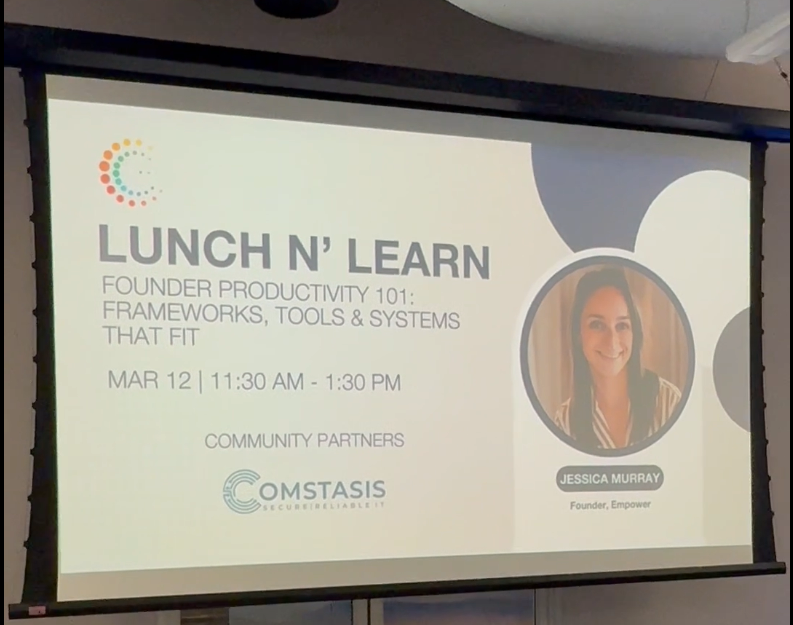
Last week, I stood in front of a room of entrepreneurs and presented on the topic of productivity. One was building a product to stop porch piracy. Another was raising money for an activewear brand. One ran a wastewater construction operation. Another had just launched a fragrance line. The list goes on.
Different industries. Different stages. Similar challenges related to increasing output and optimizing resources.
I didn't walk in with a tool recommendation or a framework to prescribe. Instead, I left the audience with a mental model. Something that can outlast a shiny new piece of software and provide a better foundation for increasing productivity going forward.
The chaotic hustle
Before going too far, there’s something important to name.
I don’t think I’ve met a founder in the past 12 years who hasn’t reached an inflection point (or multiple) during which they’ve managed 3+ roles within the company, handling all the fire drills and trying to grow the business simultaneously. It’s overwhelming. It’s hard. It doesn’t always feel…awesome.
So, if this is you and you feel defeated, it’s important to acknowledge two things:
You’re not alone.
This might actually be a signal of growth.
The processes, tools and habits that got you early traction were built for a different stage. They were scrappy by design. The circumstance outlined above is merely a signal it’s time to adapt and evolve.
Staying in this loop isn’t heroic. Don’t try to run through brick walls with the wrong infrastructure, pushing past the point those early systems were meant to hold.
The chaotic hustle has a shelf life. Recognizing that is the first move.
Don’t knee-jerk to the quick fix or “the tool”
When things feel slow or inefficient, the instinct is to quickly reach for a solution. Usually a tool. Sometimes a framework. Other times, throwing another body at the problem.
Time is precious.
You can’t waste it. You feel the impulse to act.
But most of the time, the tool is the wrong place to start. You’ll inadvertantly address only a symptom; not the root of the challenge.
Here’s how I often see this misdiagnosis surface:
"We need a better project management tool." What the actual problem may be: no one owns the work. 🔥 take: Giving everyone visibility into tasks no one is responsible for doesn't create accountability. It only makes the lack of accountability more organized.
"We need clearer goals." What the actual problem may be: there are too many priorities and no one has been willing to cut the list. 🔥 take: A better goal-setting framework won't help if leadership isn't ready to make the trade-off.
"We need to move faster." What the actual problem may be: the founder is the decision bottleneck. Everything requires their sign-off, explicitly or implicitly. 🔥 take: No tool magically speeds that up.
Does any of this sound familiar? If the answer is yes, stop, take a deep breath.
A quick fix feels like progress. But, you know what’s going to waste more time? Pushing down a solution before the real breakdown is firmly understood.
Read on. I’ll provide a three-step mental model that can help you move the needle more productively.
The three-step model I use instead
During the lunch-and-learn, I told the room the following: “I’ll never stand up in front of a founder or group and say, ‘here's the tool you should use for [use case].’ There’s not enough context.”
I’ve also seen enough over the years to know that one tool, framework or operating system works brilliantly in one organization and fails miserably in another. Instead, I recommended three steps to better understand what’s causing productivity gaps and how to solve for the breakdowns:
Step 1: The Gut Check. Big picture, reaffirm and get honest with yourself. What kind of business are you building? What game are you playing? In concrete terms, what does the business look like 12 months from now? Without this clarity, it will be hard to point in the right direction.
Step 2: The Reality Audit. Now that you’re grounded in the big picture, dig deeper into what’s causing inefficiencies. Where are the workflow choke points? Who owns the work? Where are you slowing down decision-making? What’s consuming time outside your zone of genius? This means getting honest about where time is going, how decisions stall out and when the team is waiting on you. The answers may surprise you. Another reason not to jump to the solution too fast.
Step 3: Uncover the Patterns. Only after the first two steps do we talk about solutions. Now, you have enough information to uncover patterns and pinpoint what needs to be solved. As you analyze solutions, think in three layers. Operating systems structure how you and the business run, frameworks shape thinking and drive decision-making and tools are the scaffolding that support execution (Note: tools are the third, bottom layer here).
Hopefully, you’re starting to see how these three steps become a forcing function to uncover the real challenge to overcome and get you beyond the surface-layer.
Implement. Then, be a good parent.
Once you’ve done the analysis, you’ve researched and put in motion productivity solutions, the message I’ll leave you with is: Be a good parent.
Being a good parent requires driving direction, serving as the role model and delivering constant reinforcement.
The same is true of integrating new systems, frameworks and tools. There’s no set it and forget it.
As the leader, you must:
Be decisive about the path.
Communicate the “why.”
Lead by example and show what good looks like.
Repeat. Reinforce. Repeat.
I used the analogy of potty training in the session. No parent does one day of potty training, and then magically their kid never has another accident.
You repeat the expectation.
You reinforce the habit.
You course-correct when things drift.
Then, one day, it all clicks because you stayed consistent long enough for it to become the new normal.
Where can you start?
If you’re not feeling at peak productivity, here are three actions to take in 30 days:
Run a diagnostic. Examine the workflows, talk to your team and analyze where you’re spending time. Document where things slow down. Be specific.
Stack rank by impact and effort. Which items, if addressed, would unlock the most? Which of those are the lowest-lift to fix? Pick 1-2 as your starting point.
Set the check-in: Mark your calendar for 30 days from now to stay accountable for your progress. Check in on what you did, how it worked and any early shifts you observed.
That is how you stop the spiral. Not by solving everything at once. Not trying tools until you feel restless. But, in taking an honest look at the inside and making consistent small moves that build on each other.